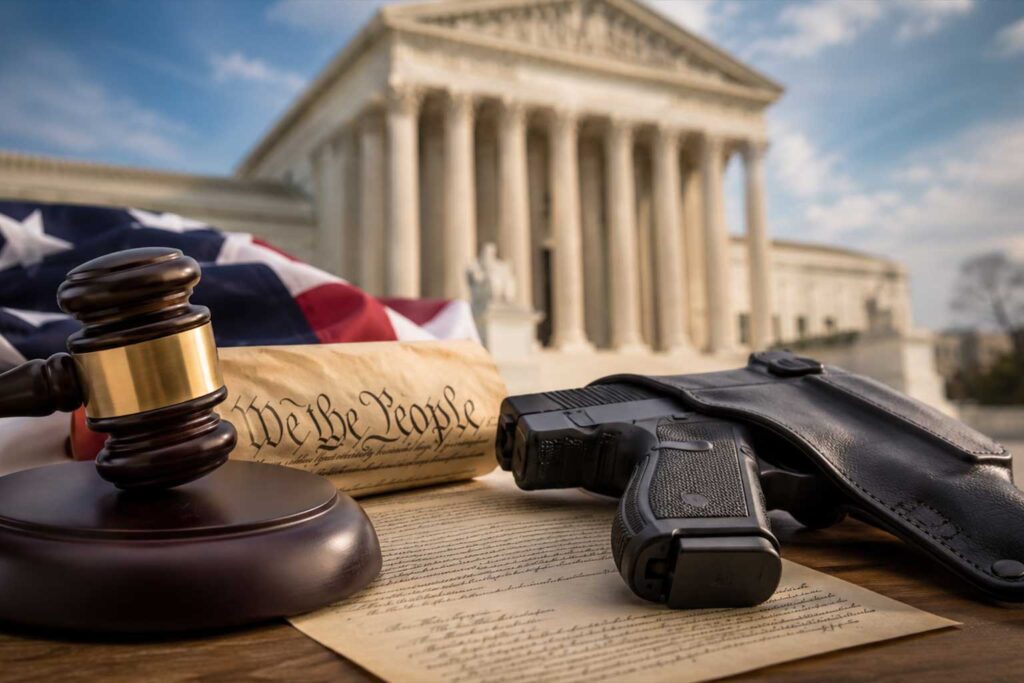
The U.S. Supreme Court is nearing the end of its current term, and two major firearms-related cases could have a significant impact on how Second Amendment rights are interpreted across the country.
The first case involves a federal law that prohibits unlawful users of controlled substances from possessing firearms. The case has drawn attention because it raises a difficult question: can the government broadly disarm someone based on drug use, even when there is no evidence that the person was intoxicated or dangerous while possessing a firearm?
The second case involves a Hawaii law that restricts concealed carry on private property open to the public unless the property owner gives express permission. In practical terms, that kind of rule can turn many ordinary public-facing businesses into default gun-free zones unless they specifically opt in to allowing concealed carry.
Both cases are being watched closely because they follow the Supreme Court’s 2022 Bruen decision, which changed how courts evaluate gun laws. Under that framework, modern firearm restrictions must be consistent with the nation’s historical tradition of firearm regulation. That has led courts to examine whether today’s gun laws have a meaningful historical analogue from the Founding era or Reconstruction period.
For gun owners, firearm businesses, and Second Amendment advocates, the rulings could matter far beyond the specific facts of each case.
The controlled-substance case could affect how the federal government enforces firearm prohibitions against marijuana users and others accused of unlawful drug use. This is especially important because marijuana laws now vary widely from state to state, while federal law still treats marijuana as a controlled substance.
The Hawaii case could affect public carry rights in states that have passed strict post-Bruen carry laws. If the Court rejects Hawaii’s approach, it could limit the ability of states to make large categories of otherwise public places off-limits to licensed carriers.
Together, these cases show that the Supreme Court is continuing to define the boundaries of the Second Amendment after Bruen. The central question is no longer simply whether a gun law is considered “reasonable” by modern policy standards. Instead, courts are asking whether the restriction fits within America’s historical tradition of firearm regulation.
A ruling against the federal drug-user firearm ban could narrow when the government can disarm someone based on substance use. A ruling against Hawaii’s private-property carry restriction could strengthen the right of licensed citizens to carry in places open to the public.
However, the details will matter. The Court could issue broad rulings that reshape national Second Amendment law, or it could decide the cases more narrowly. Either way, these decisions are expected to influence future challenges to firearm restrictions across the country.
For firearm owners and customers in Texas, these cases are worth following because Supreme Court decisions set the constitutional framework that affects laws nationwide. Even when a case begins in Hawaii or under federal drug law, the final ruling can shape how courts handle Second Amendment disputes everywhere.
At County Armory, we believe responsible firearm ownership starts with staying informed. As these cases develop, we will continue watching how the courts define the rights and responsibilities of gun owners, concealed carriers, and firearm businesses.
https://www.reuters.com/world/us-supreme-court-hear-challenge-hawaii-handgun-limits-2025-10-03/
https://www.oyez.org/cases/2025/24-1046
https://www.washingtonpost.com/politics/2026/03/02/supreme-court-marijuana-gun-hemani/